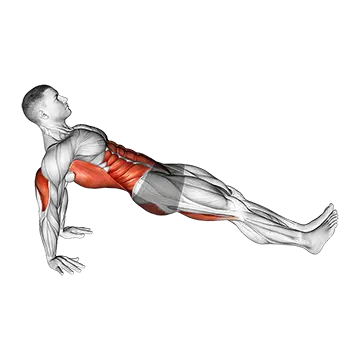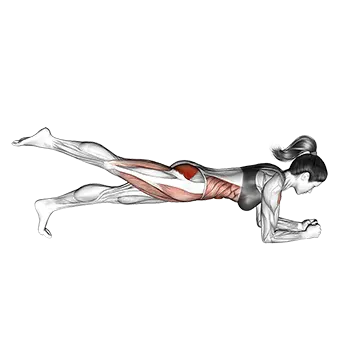
Front Plank with Leg Lift
- Target muscle
- Gluteus Maximus, Rectus Abdominis
- Synergist muscles
- Deltoid Anterior, Hamstrings, Iliopsoas, Obliques, Pectoralis Major Clavicular Head, Pectoralis Major Sternal Head, Serratus Anterior, Tensor Fasciae Latae
- Equipment
- Body weight
- Body part
- Hips, Waist
- Type
- Strength
The front plank with leg lift is a bodyweight core exercise that builds on the standard forearm plank by raising one straight leg at a time. Lifting the leg drives the glutes and hamstrings into hip extension while your abs and obliques brace hard to resist rotation and keep the hips level. The shoulders, chest, and serratus anterior also work to stabilize you on your forearms, making it a strong anti-rotation and glute-activation drill.
How to do the Front Plank with Leg Lift
- 1Set up on the floor on your forearms with your elbows directly under your shoulders and your forearms parallel, hands flat or fists down.
- 2Extend your legs straight behind you and rest on your toes, feet about hip-width apart.
- 3Brace your abs, squeeze your glutes, and form a straight line from your head through your hips to your heels.
- 4Without rotating your hips, lift one straight leg a few inches off the floor by squeezing the glute and hamstring of that leg.
- 5Hold the lifted leg for a one to two count while keeping your hips square and level to the floor.
- 6Lower the leg under control back to the start without letting your hips sag or twist.
- 7Repeat with the other leg, alternating sides for your target number of reps.
- 8Finish by lowering both knees to the floor and releasing the plank.
Form tips
- Keep your hips square to the floor throughout — picture a glass of water on your lower back that you can't spill as you lift each leg.
- Lift from the glute and hamstring, not by hinging at the lower back; a small lift with the leg fully straight beats a high lift with an arched spine.
- Press your forearms and elbows into the floor and spread your shoulder blades slightly to engage the serratus and stay stable.
- Keep your neck long and your gaze just ahead of your hands so your head stays in line with your spine.
- Breathe steadily through each lift rather than holding your breath, keeping the brace constant.
Common mistakes
- Letting the hips rotate or hike up as the leg lifts, which removes the anti-rotation challenge and lets the core stop working.
- Arching the lower back to raise the leg higher, which loads the spine instead of the glutes and risks low-back strain.
- Letting the hips sag toward the floor, which collapses the plank line and shifts stress onto the lower back.
- Bending the lifted knee, which lets the hip flexors take over and reduces the glute and hamstring work.
- Rushing the reps, swinging the leg up and down instead of controlling the lift and lowering.
Frequently asked questions
What muscles does the front plank with leg lift work?
It primarily targets the glutes and abs. The hamstrings, hip flexors, obliques, outer hip, front shoulders, chest, and serratus anterior assist by extending the hip and stabilizing your body on your forearms.
How is it different from a regular front plank?
A standard plank is a static hold for the core. Adding the leg lift makes it dynamic: it forces your glutes and hamstrings into hip extension and challenges your abs and obliques to resist the rotation each lift creates.
How high should I lift my leg?
Only a few inches — just to where you feel the glute and hamstring working while your hips stay square and level. Lifting higher usually means arching the lower back, which defeats the purpose and stresses the spine.
Is the front plank with leg lift good for beginners?
It's an intermediate progression. If you can't hold a steady forearm plank for 20–30 seconds with level hips, master the standard plank first, then add the leg lift once your core can stay stable.
How many reps should I do?
Start with 6–10 controlled lifts per leg, alternating sides, for 2–3 sets. Stop the set once your hips start to sag or twist, since form matters more than reps here.