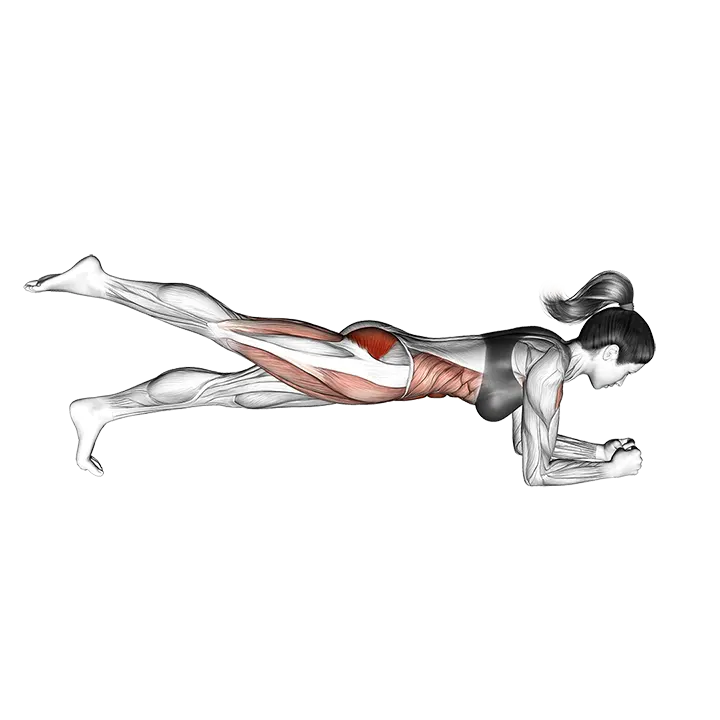
Single Leg Bridge
- Target muscle
- Gluteus Maximus, Rectus Abdominis
- Synergist muscles
- Deltoid Anterior, Hamstrings, Obliques, Serratus Anterior, Tensor Fasciae Latae
- Equipment
- Body weight
- Body part
- Hips
- Type
- Strength

The Single Leg Bridge is a bodyweight strength exercise that targets the gluteus maximus and rectus abdominis by requiring you to hold your pelvis level while driving through a single planted heel to lift your hips off the floor. The unilateral demand also engages the hamstrings, obliques, and tensor fasciae latae to resist pelvic drop and rotation. It is an effective movement for building single-leg hip stability, correcting glute imbalances, and improving core control.
How to do the Single Leg Bridge
- 1Lie on your back with your knees bent and feet flat on the floor, hip-width apart.
- 2Extend one leg straight out, keeping it in line with your bent knee so both thighs are parallel.
- 3Place your arms flat at your sides with palms facing down for support.
- 4Brace your core and squeeze your glutes before initiating the movement.
- 5Press firmly through the heel of your planted foot and lift your hips until your body forms a straight line from your shoulders to the raised knee.
- 6Hold the top position for one to two seconds, keeping the extended leg level with your torso.
- 7Lower your hips slowly back to the floor under control.
- 8Complete all reps on one side before switching to the other leg.
Form tips
- Set the planted heel about a hand's length from your glutes. Closer than that shifts work toward the quads; farther away shifts it toward the hamstrings.
- Tuck your ribs down and tilt your pelvis slightly toward your face before the first rep — starting from that position lets the glute produce the range instead of the lumbar spine.
- Press the backs of your arms and shoulders into the floor as you lift; that anchor gives the anterior deltoid and serratus anterior something to stabilize against so your torso does not twist.
- If the hamstring of the working leg starts to cramp, walk that foot slightly closer to your hips and initiate the lift with a deliberate glute squeeze.
- Match your tempo side to side — use the same lift, hold, and lower count on the weaker leg so the stronger side does not mask the imbalance you are training to fix.
Common mistakes
- Letting the hip on the extended-leg side drop below the working hip — this removes tension from the gluteus maximus and places asymmetric stress on the lower back.
- Hyperextending the lumbar spine at the top instead of truly extending the hip, which loads the lower back rather than the glutes.
- Pushing through the toes rather than the heel, which reduces hamstring and glute engagement and shifts stress to the knee.
- Rushing through reps without controlling the descent — a fast, uncontrolled lowering phase eliminates the eccentric demand and increases injury risk.
- Holding the breath throughout the set, which raises intra-abdominal pressure unnecessarily; exhale as you lift, inhale as you lower.
Frequently asked questions
What muscles does the Single Leg Bridge work?
The Single Leg Bridge primarily targets the gluteus maximus and rectus abdominis. The hamstrings, obliques, and tensor fasciae latae act as synergists to extend the hip and keep the pelvis level, while the deltoid anterior and serratus anterior provide upper-body stabilization against the floor.
What is the difference between a Single Leg Bridge and a regular glute bridge?
A regular glute bridge uses both feet planted, splitting the load evenly between both sides. The Single Leg Bridge removes one point of support, which increases the demand on the working glute and forces the core — especially the obliques and rectus abdominis — to prevent pelvic tilt and rotation. This makes it more effective for identifying and correcting side-to-side strength imbalances.
How many reps should I do for the Single Leg Bridge?
A typical starting range is 8–12 reps per leg for 2–3 sets, with a 1–2 second hold at the top of each rep. Focus on quality over quantity — reduce reps if your hip begins to drop or your lower back takes over before the set is complete.
Can I do the Single Leg Bridge every day?
Yes, because it uses only bodyweight and is low impact, most people can perform it daily as part of a warm-up or activation routine without meaningful recovery cost. If you are loading it heavily or using it as a primary strength exercise, allow 48 hours of recovery between sessions.
Why do I feel the Single Leg Bridge in my lower back instead of my glutes?
Lower-back dominance usually means the glutes are not activating properly or you are hyperextending the spine to gain height. Try squeezing the glute of the working leg before you lift, keep the movement range within what your hip can actually extend, and drive through the heel rather than arching through the lower back.