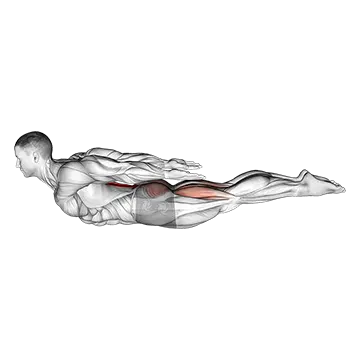
Hyperextension (on bench)
- Target muscle
- Erector Spinae
- Synergist muscles
- Gluteus Maximus, Hamstrings
- Equipment
- Body weight
- Body part
- Waist
- Type
- Strength


The hyperextension on a bench is a bodyweight exercise that primarily strengthens the erector spinae, the muscles running along your lower back, with help from the gluteus maximus and hamstrings. Performed face-down on a hyperextension or flat bench, it builds lower-back endurance and posterior-chain control without any added load.
How to do the Hyperextension (on bench)
- 1Position yourself face-down on the bench so your hips rest just past the pad and your torso can hang freely toward the floor.
- 2Anchor your ankles under the foot pads or have a partner hold your legs so your lower body stays fixed.
- 3Cross your arms over your chest or place your fingertips lightly at your temples, and let your upper body hang down to start.
- 4Brace your core and squeeze your glutes, then lift your torso upward by extending through your lower back until your body forms a straight line.
- 5Stop at the point where your shoulders, hips, and ankles align — do not arch past a neutral, straight spine.
- 6Lower your torso back down slowly under control until you feel a gentle stretch in your lower back.
- 7Complete your reps with a steady tempo, then carefully step off the bench.
Form tips
- Keep your spine neutral and move from your hips and lower back rather than jerking the rep up.
- Squeeze your glutes and hamstrings at the top to share the work across the whole posterior chain.
- Exhale as you lift and inhale as you lower, keeping your core braced throughout.
- Since this is a bodyweight movement, focus on slow, controlled reps and higher rep ranges rather than rushing.
Common mistakes
- Hyperextending past a straight line at the top, which compresses the lower spine and risks injury.
- Using momentum to swing the torso up, which removes tension from the erector spinae and reduces the benefit.
- Pulling on your head or neck when your hands are placed at your temples, straining the cervical spine.
- Dropping the torso too fast on the way down, losing control and the muscle's stretch under tension.
Frequently asked questions
What muscles does the bench hyperextension work?
It primarily targets the erector spinae of the lower back, with the gluteus maximus and hamstrings assisting as synergists.
Is the bench hyperextension good for beginners?
Yes. It is a bodyweight movement with no added load, making it a safe way to build lower-back and posterior-chain endurance when done with a controlled tempo.
How high should I lift my torso?
Lift only until your shoulders, hips, and ankles form a straight line. Going past that point into excessive arching stresses the lower spine without added benefit.
How many sets and reps should I do?
Because there is no external load, this exercise responds well to higher reps — try 2 to 3 sets of 12 to 20 controlled reps.