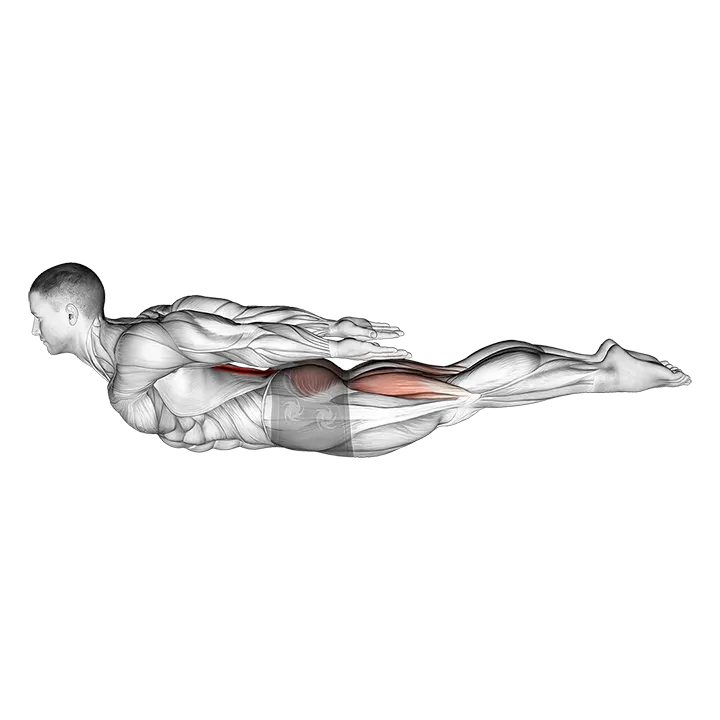
Locust Yoga Pose (Iron Man Pose)
- Target muscle
- Erector Spinae
- Synergist muscles
- Gluteus Maximus, Hamstrings
- Equipment
- Body weight
- Body part
- Back
- Type
- Stretching

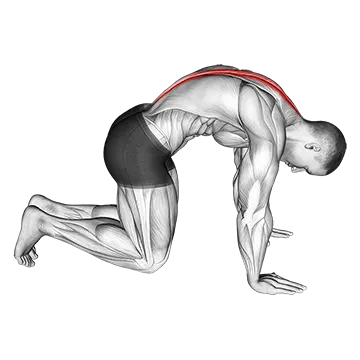



The Locust Yoga Pose, also known as the Iron Man Pose, is a bodyweight back-extension exercise that primarily targets the erector spinae, with the gluteus maximus and hamstrings working as synergists to drive the lift. Performed lying face down, it strengthens the whole posterior chain while opening the front of the body, and is an effective movement for improving spinal mobility and relieving lower-back tension.
How to do the Locust Yoga Pose (Iron Man Pose)
- 1Lie face down on a mat with your legs extended straight behind you, feet together or hip-width apart, and your arms resting alongside your body with palms facing down.
- 2Rest your forehead lightly on the mat and take a slow breath in to prepare.
- 3On an exhale, engage your core gently and press your pubic bone into the mat to stabilize your pelvis.
- 4As you inhale, simultaneously lift your head, chest, and arms off the mat, reaching your fingertips back toward your feet.
- 5Squeeze your glutes and lift your legs off the mat, keeping them straight and internally rotated so your big toes point toward each other.
- 6Hold the top position for 3–5 breaths, keeping your gaze directed slightly downward to keep the neck long.
- 7On an exhale, slowly lower your chest, arms, and legs back to the mat with control.
- 8Rest briefly with your cheek to one side before repeating.
Form tips
- Lengthen through the crown of your head rather than crunching the neck back — the goal is spinal extension, not neck compression.
- Keep your glutes firm but not gripped so hard that you lose connection with the erector spinae doing the back extension.
- Breathe steadily throughout the hold — holding your breath tightens the torso and makes the hold much harder to sustain.
- Reach actively through your fingertips and toes in opposite directions to create full-body lengthening rather than just lifting.
- Press your pubic bone and lower abdomen gently into the mat to protect the lumbar spine during the lift.
Common mistakes
- Cranking the neck sharply backward to look up, which compresses the cervical spine and defeats the purpose of the spinal extension.
- Bending the knees during the leg lift, which shifts the work onto the hip flexors and cuts hamstring and glute engagement.
- Holding the breath, which spikes blood pressure and forces you out of the hold early instead of building endurance in the back extensors.
- Settling for lifting only the upper body once you can do the full pose, which under-trains the glutes and hamstrings that should be driving the leg lift.
- Rushing the lowering phase and dropping to the mat, which removes the eccentric control that builds back strength over time.
Frequently asked questions
What muscles does the Locust Pose work?
The Locust Pose primarily works the erector spinae along the spine. The gluteus maximus and hamstrings act as synergists to help lift and hold the legs off the mat.
Is the Locust Pose good for lower back pain?
For many people, gentle back-extension exercises like the Locust Pose help strengthen the erector spinae and may reduce lower-back discomfort. However, if you have an acute injury or disc issues, consult a healthcare provider before attempting this pose.
How long should I hold the Locust Yoga Pose?
A common approach is to hold the top position for 3–5 slow breaths (roughly 15–30 seconds), rest, and repeat 2–3 times. Prioritize control and breathing over duration.
What is the difference between the Locust Pose and a Superman exercise?
They are very similar — both are prone back-extension movements lifting the chest and legs simultaneously. The Locust Pose is rooted in yoga and emphasizes breath and full-body lengthening, while the Superman is typically performed as a dynamic repetition-based exercise.
Can beginners do the Locust Yoga Pose?
Yes. Beginners can start by lifting only the upper body or only the legs separately before combining both, gradually building erector spinae and glute strength to hold the full pose.