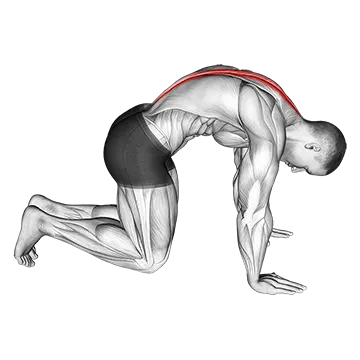
Lying Floor Hyperextension
- Target muscle
- Erector Spinae
- Synergist muscles
- Gluteus Maximus, Hamstrings
- Equipment
- Body weight
- Body part
- Hips
- Type
- Strength
The lying floor hyperextension is a bodyweight exercise that targets the erector spinae along the length of the spine, with assistance from the gluteus maximus and hamstrings. Performed face-down on the floor, it trains spinal extension without any equipment and is commonly used to build lower-back endurance and reinforce proper posterior-chain recruitment.
How to do the Lying Floor Hyperextension
- 1Lie face-down on the floor with your legs straight and your arms either crossed behind your head or extended alongside your body.
- 2Press your hips and lower abdomen firmly into the floor to anchor your pelvis.
- 3Squeeze your glutes and engage your hamstrings before initiating any movement.
- 4Exhale and lift your chest, shoulders, and upper torso off the floor by contracting the erector spinae.
- 5Raise only as high as comfortable — typically 4 to 8 inches — keeping the movement controlled and your neck neutral.
- 6Hold the top position for one to two seconds while maintaining muscle tension.
- 7Inhale and lower your torso back to the floor in a slow, controlled manner.
- 8Repeat for the desired number of repetitions without losing pelvic contact with the floor.
Form tips
- Keep your gaze directed toward the floor throughout the lift to maintain a neutral cervical spine rather than craning your neck upward.
- Focus on initiating the movement from the lower back and glutes rather than pushing with your hands or swinging momentum.
- Limit your range of motion to what the lower back can achieve under muscular control — excessive height adds stress without extra benefit.
- Breathe out on the way up and in on the way down to coordinate intra-abdominal pressure with the effort phase.
Common mistakes
- Lifting the hips off the floor: allows the pelvis to rotate and shifts load away from the erector spinae, reducing effectiveness and stressing the lumbar joints unevenly.
- Jerking or using momentum: swinging the torso up quickly bypasses the target muscles and can strain the intervertebral discs.
- Hyperextending the neck: tilting the head back to look forward compresses the cervical spine; the neck should stay in line with the rest of the spine.
- Going too high: forcing range of motion beyond what the muscles control increases lumbar compression and does not add meaningful stimulus to the erector spinae.
Frequently asked questions
What muscles does the lying floor hyperextension work?
The primary muscle worked is the erector spinae, the group of muscles that runs along both sides of the spine and is responsible for extending and stabilizing the back. The gluteus maximus and hamstrings assist by stabilizing the pelvis and extending the hips during the lift.
How is the lying floor hyperextension different from a back extension machine?
Both exercises train the same muscles, but the floor version uses only bodyweight and anchors the pelvis against the ground rather than a pad. This limits the range of motion compared to a machine or hyperextension bench, making it a lower-load option suitable for beginners or situations where equipment is unavailable.
How many reps and sets should I do for lying floor hyperextensions?
For lower-back endurance and general strengthening, 2 to 4 sets of 10 to 20 repetitions works well. Because the load is bodyweight only and the range of motion is limited, higher rep ranges are common. Focus on slow, controlled reps rather than chasing high numbers.
Can I do lying floor hyperextensions every day?
The erector spinae recovers relatively quickly from low-load bodyweight work, so performing this exercise daily is feasible for many people. However, if you notice persistent lower-back fatigue or soreness, allowing a rest day between sessions is advisable.
Are lying floor hyperextensions safe for people with lower-back pain?
For some individuals with lower-back discomfort, gentle spinal extension exercises can be beneficial, but this depends heavily on the cause of the pain. Anyone with a diagnosed disc herniation, spinal stenosis, or acute back injury should consult a healthcare professional before performing any spinal extension exercise.