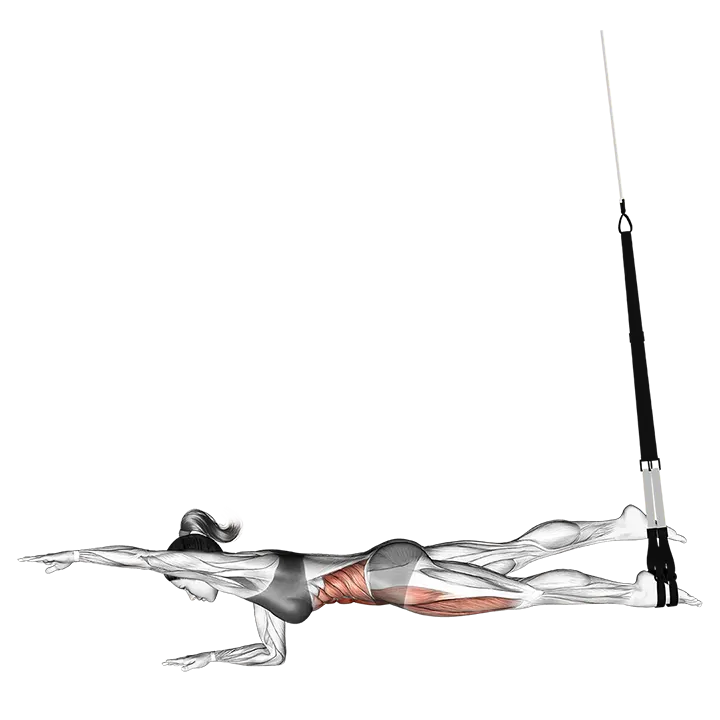
Suspension Single Leg Plank (straight arm)
- Target muscle
- Rectus Abdominis
- Synergist muscles
- Obliques, Quadriceps, Tensor Fasciae Latae
- Equipment
- Suspension
- Body part
- Waist
- Type
- Strength

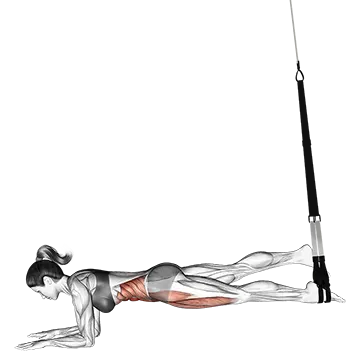
The Suspension Single Leg Plank (straight arm) is a core stability exercise performed in a push-up position with both feet in suspension straps and one leg raised, primarily targeting the rectus abdominis. The obliques, quadriceps, and tensor fasciae latae work as synergists to keep your hips level and your body aligned. It fits well as an advanced core exercise in strength or conditioning sessions.
How to do the Suspension Single Leg Plank (straight arm)
- 1Set the suspension straps to a low position, roughly 6–12 inches off the ground.
- 2Kneel facing away from the anchor point and place both feet into the foot cradles of the straps.
- 3Walk your hands out and assume a straight-arm push-up position with your hands directly under your shoulders.
- 4Brace your core, squeeze your glutes, and align your body in a straight line from head to heels.
- 5Lift one foot out of its cradle and extend that leg straight back, holding it at hip height.
- 6Hold this single-leg plank position, keeping your hips level and your lower back from sagging or hiking up.
- 7Breathe steadily throughout the hold — do not hold your breath.
- 8Return the raised foot to its cradle, then switch legs for the next set or rep.
Form tips
- Push the floor away through your palms to keep your shoulders packed and stable rather than shrugging toward your ears.
- Drive the heel of the raised leg back and slightly up to keep your hip square and prevent rotation.
- Keep your gaze a few inches in front of your hands to maintain a neutral neck aligned with your spine.
- Squeeze your obliques and think about pulling your navel toward your spine to resist the straps' instability.
- Start with shorter holds (10–15 seconds per side) until you can maintain perfect alignment before increasing duration.
Common mistakes
- Letting the hips sag toward the floor: this shifts load off the rectus abdominis and places compressive stress on the lumbar spine.
- Hiking the hip of the raised leg: rotating or lifting the hip to compensate for instability reduces oblique engagement and creates asymmetrical spinal loading.
- Bending the elbows: letting the arms flex drops you toward a forearm plank and removes the shoulder and straight-arm stability demand this version is designed to train.
- Looking up or dropping the head: either position breaks neutral spine alignment and increases cervical strain over a sustained hold.
- Placing the straps too high: a higher strap position reduces core instability challenge and changes the body angle, making the exercise easier but less effective as a plank variation.
Frequently asked questions
What muscles does the Suspension Single Leg Plank (straight arm) work?
The primary target is the rectus abdominis, which resists spinal extension under load. The obliques stabilize rotation, the quadriceps keep the raised leg extended, and the tensor fasciae latae assists with hip stability on the lifted side.
How is this different from a regular plank?
Two factors increase the demand: the suspension straps create an unstable surface that forces your core to work harder to prevent unwanted movement, and lifting one leg removes a base of support, requiring greater oblique and hip-stabilizer engagement to keep your hips level.
How long should I hold the single-leg position?
Aim for holds of 15–30 seconds per side once you can maintain clean form throughout. If your hips rotate or drop before the hold ends, shorten the duration and build from there. Quality of position matters more than duration.
What strap height works best for this exercise?
Set the foot cradles 6–12 inches off the ground. A lower position brings your torso closer to horizontal, which increases the load your core has to resist. Beginners can start slightly higher to build confidence with the instability before lowering the straps.
Can beginners do this exercise?
It is better suited to intermediate trainees who can already hold a stable two-leg suspension plank for 30 or more seconds. Build that base first, then progress to the single-leg variation to ensure your core can handle the added instability and asymmetry.