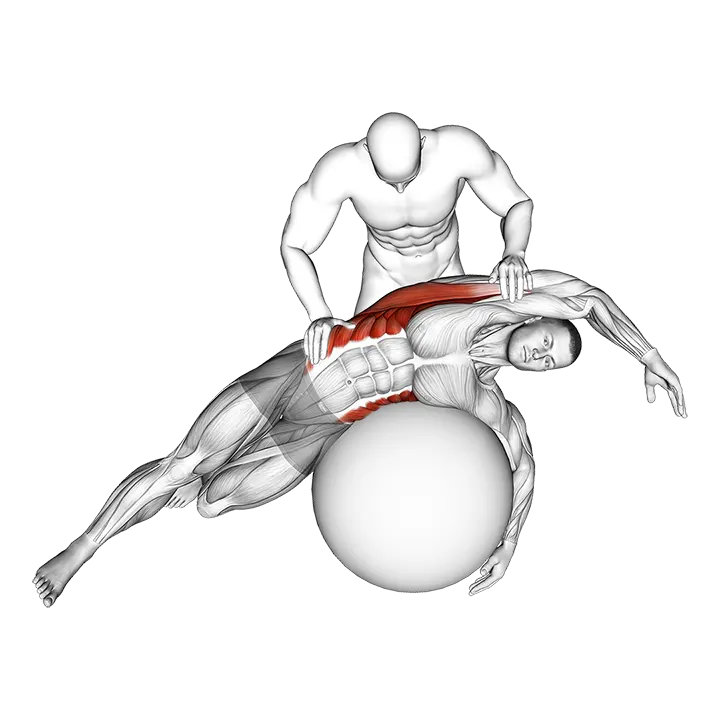
Assisted Oblique And Latissimus Dorsi Stretch On Stability Ball
- Target muscle
- —
- Equipment
- Assisted
- Body part
- Back
- Type
- Stretching

The assisted oblique and latissimus dorsi stretch on a stability ball is a partner-assisted flexibility drill for the side of the trunk and back, where the stretch is felt along the obliques and the latissimus dorsi (lats). Draping sideways over a stability ball opens up the rib cage and waist while a partner gently guides you into a deeper side bend than you could reach alone. It is a good way to ease a tight side and improve overhead and rotational mobility after training or long sitting.
How to do the Assisted Oblique And Latissimus Dorsi Stretch On Stability Ball
- 1Kneel beside a stability ball and lean your side onto it so the ball supports your ribs and waist.
- 2Extend your top arm overhead in line with your body and let your top leg straighten out to the side for a wide, stable base.
- 3Let your partner stand behind you and lightly steady your hip and shoulder so you can relax onto the ball.
- 4Drape your trunk sideways over the ball, reaching the top arm long until you feel a gentle stretch down your side and into the lats.
- 5Have your partner slowly guide your top arm and shoulder a little further over the ball to deepen the stretch.
- 6Keep your hips stacked and facing forward so the stretch stays along the obliques rather than twisting the spine.
- 7Hold the position and breathe slowly, letting the side of your trunk relax and lengthen without forcing it.
- 8Have your partner ease you back upright under control, then switch sides and repeat.
Form tips
- Communicate clearly with your partner so they guide you only to the point of a mild stretch, never into sharp pain.
- Reach the top arm long and overhead rather than just leaning, so the stretch travels through the obliques and into the lats.
- Keep your hips stacked and square to lengthen the side of the trunk cleanly instead of collapsing into a twist.
- Breathe out as your partner guides you deeper and stay relaxed; tension in the side limits how far it will open.
- Let the stability ball carry your weight so your trunk can soften over it instead of bracing against the stretch.
Common mistakes
- Letting your partner push you over too far too fast, which can strain the obliques instead of stretching them.
- Rotating the hips or shoulders into a twist, which pulls the stretch off the obliques and lats and can stress the lower back.
- Keeping the top arm down by your side, which shortens the lats and removes the stretch from the side of the trunk.
- Tensing up and gripping the ball, which makes the muscles resist lengthening and reduces the stretch.
- Letting the ball roll out from under you on an unstable surface, which breaks the position and risks a fall.
Frequently asked questions
What muscles does the assisted oblique and latissimus dorsi stretch on a stability ball work?
It stretches the obliques along the side of your trunk and the latissimus dorsi (lats) of the back. Draping sideways over the ball with the top arm reached overhead is what places the lengthening tension on them.
Where should I feel this stretch?
You should feel a gentle pull down the side of your trunk, from the waist up through the ribs and into the back under the armpit. You should not feel sharp pain in the spine or lower back.
How long should I hold the stretch?
Hold it for about 20–30 seconds per side and repeat two or three times on each side. Ease a little deeper with each round as the obliques and lats relax.
Is this stretch good for beginners?
Yes. Because the stability ball supports your weight and a partner controls the movement, it is a safe way for beginners with a tight side or stiff back to stretch further than they could alone, as long as they communicate clearly.
Can I do this stretch without a partner?
You can do a similar stretch alone by draping over the stability ball and reaching your top arm overhead, but a partner lets you relax fully and gently guides you into a more controlled, deeper stretch.
Related exercises
 Assisted Chin TuckNeck
 Assisted Hanging Knee RaiseWaist
 Assisted Hanging Knee Raise With Throw DownWaist
 Assisted Inverse Leg CurlThighs
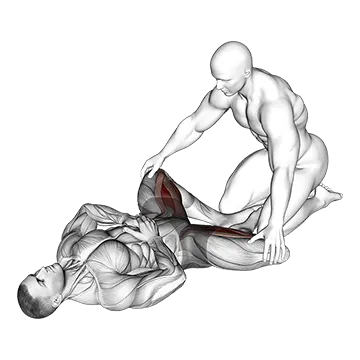 Assisted Lying Adductors StretchHips
 Assisted Lying Gastrocnemius StretchCalves
 Assisted Lying Gluteus And Piriformis StretchHips
 Assisted Lying Gluteus Maximus StretchHips