
Assisted Prone Rectus Femoris Stretch
- Target muscle
- —
- Equipment
- Assisted
- Body part
- Waist
- Type
- Stretching

The assisted prone rectus femoris stretch is a partner-assisted flexibility drill that lengthens the rectus femoris — the long quadriceps muscle that also crosses the hip — along with the hip flexors at the front of the thigh and hip. Performed lying face down while a partner gently raises your heel toward your glutes, it helps restore knee and hip mobility and is useful for relieving tight quads after squats, running, or long periods of sitting.
How to do the Assisted Prone Rectus Femoris Stretch
- 1Lie face down (prone) on a mat with your legs extended and your hips pressed flat into the floor.
- 2Relax your upper body, rest your forehead on your hands or the mat, and keep both hips square and in contact with the ground.
- 3Have your partner kneel beside the leg to be stretched and support it just above the ankle.
- 4Let your partner slowly bend your knee, guiding your heel toward your glutes until you feel a comfortable stretch down the front of your thigh.
- 5Keep your hip pinned to the floor so the stretch stays in the quad and hip flexor rather than arching your lower back.
- 6Hold the position for 20–30 seconds, breathing slowly and staying relaxed.
- 7Have your partner ease the leg back down under control, then switch sides and repeat.
Form tips
- Communicate constantly with your partner — the stretch should feel like a firm pull, never a sharp or pinching pain.
- Keep both hips flat and level on the floor; lifting the hip lets the body cheat out of the stretch.
- Breathe out as the heel approaches your glutes and try to relax the quad rather than resisting the movement.
- Warm up the legs lightly before stretching cold muscles, and ease deeper only as the tissue releases.
Common mistakes
- Letting the hip lift off the floor, which arches the lower back and shifts strain off the target muscle onto the spine.
- Pushing the heel too hard or too fast, which can overload the knee joint and trigger a protective muscle reflex.
- Bouncing the leg toward the glutes instead of holding a steady stretch, which raises the risk of a muscle strain.
- Holding your breath and tensing up, which keeps the quad contracted and prevents it from lengthening.
Frequently asked questions
What muscles does the assisted prone rectus femoris stretch work?
It mainly lengthens the rectus femoris, the long quadriceps muscle on the front of the thigh, and stretches the hip flexors. Because the rectus femoris crosses both the hip and the knee, the prone position targets it more directly than a standing quad stretch.
Why is this stretch done lying face down?
Lying prone keeps the hip extended and flat, which puts the rectus femoris on full stretch across both the hip and knee. It also lets a partner control the movement safely while you stay relaxed.
How long should I hold the stretch?
Hold each side for about 20–30 seconds and repeat 2–3 times per leg. Keep the stretch steady and pain-free rather than forcing the heel closer.
Is this a good stretch for beginners?
Yes. Because a partner controls the range of motion, it suits beginners and people with tight quads — just communicate clearly so the stretch stays comfortable and the hip stays on the floor.
Related exercises
 Assisted Chin TuckNeck
 Assisted Hanging Knee RaiseWaist
 Assisted Hanging Knee Raise With Throw DownWaist
 Assisted Inverse Leg CurlThighs
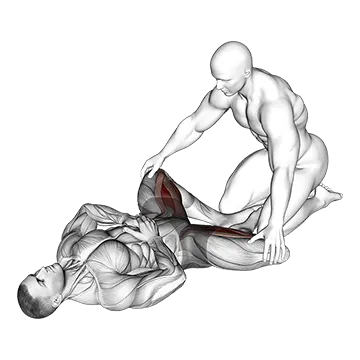 Assisted Lying Adductors StretchHips
 Assisted Lying Gastrocnemius StretchCalves
 Assisted Lying Gluteus And Piriformis StretchHips
 Assisted Lying Gluteus Maximus StretchHips