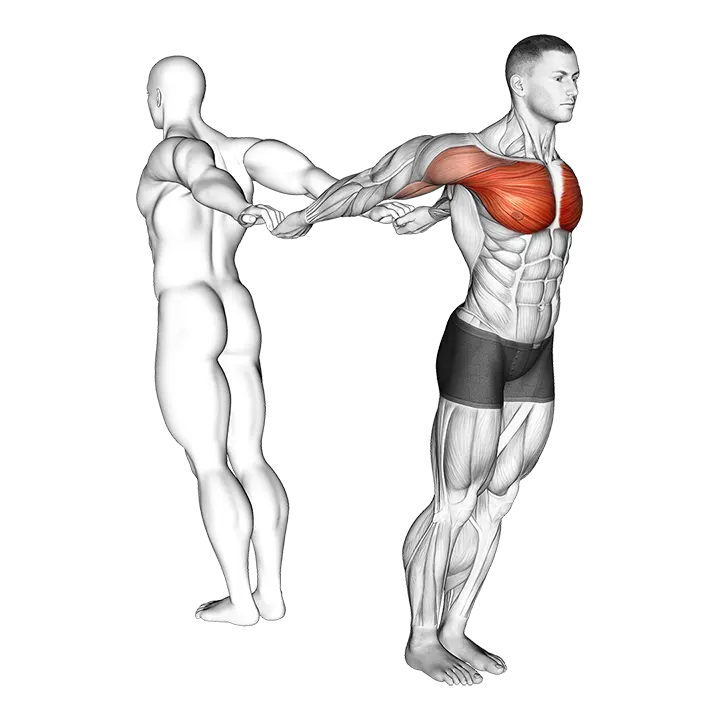
Assisted Pulling Backs Chest Stretch
- Target muscle
- —
- Equipment
- Assisted
- Body part
- Chest
- Type
- Stretching
The assisted pulling backs chest stretch is a partner-assisted stretch that opens up the chest (pectorals) and the front of the shoulders. Your partner gently draws your arms back behind your body to lengthen the muscles across your chest, making it a useful warm-up or cool-down move for anyone who sits a lot or trains pushing exercises.
How to do the Assisted Pulling Backs Chest Stretch
- 1Stand tall with your feet about hip-width apart, chest lifted and core lightly braced.
- 2Have your partner stand directly behind you within easy reach of your arms.
- 3Extend both arms out to your sides or slightly behind you, keeping your elbows soft and your palms facing forward.
- 4Let your partner take hold of your wrists or forearms with a secure, comfortable grip.
- 5Ask your partner to slowly draw your arms back and together behind your body until you feel a gentle stretch across your chest.
- 6Keep your shoulders down away from your ears and breathe slowly as the stretch deepens.
- 7Hold the position at a comfortable point of tension without forcing the range of motion.
- 8Have your partner release the pull gradually, then lower your arms and relax.
Form tips
- Communicate constantly with your partner and stop them the moment you reach a mild stretch — they cannot feel what you feel.
- Exhale as your arms are drawn back to help your chest relax into the stretch.
- Keep your spine tall and avoid arching your lower back to compensate for limited shoulder mobility.
- Ease into the position slowly rather than bouncing, holding the stretch for roughly 20–30 seconds.
- Use this stretch after pushing exercises or long periods of sitting to counter rounded-shoulder posture.
Common mistakes
- Letting your partner pull too hard or too fast, which can overstretch and strain the shoulder joint.
- Shrugging the shoulders up toward the ears, which adds neck tension and reduces the chest stretch.
- Holding your breath, which keeps the muscles tense and limits how much they release.
- Arching the lower back to force more range, shifting the stretch away from the chest and stressing the spine.
- Bouncing into the end range instead of holding a steady position, which raises the risk of injury.
Frequently asked questions
What muscles does the assisted pulling backs chest stretch work?
It stretches the chest (pectoral muscles) and the front of the shoulders by drawing the arms back behind the body, lengthening the muscles across the front of the torso.
How long should I hold this chest stretch?
Hold the stretch for about 20–30 seconds at a comfortable point of tension, and repeat for 2–3 rounds. Avoid pushing into pain at any point.
Is the assisted pulling backs chest stretch good for beginners?
Yes, as long as your partner moves slowly and you communicate. Because someone else controls the range, clear feedback is essential so they ease off the moment you feel a mild stretch.
What is a good alternative if I do not have a partner?
A doorway chest stretch or a standing chest stretch with your hands clasped behind your back targets the same chest and front-shoulder muscles without needing assistance.
Related exercises
 Assisted Chin TuckNeck
 Assisted Hanging Knee RaiseWaist
 Assisted Hanging Knee Raise With Throw DownWaist
 Assisted Inverse Leg CurlThighs
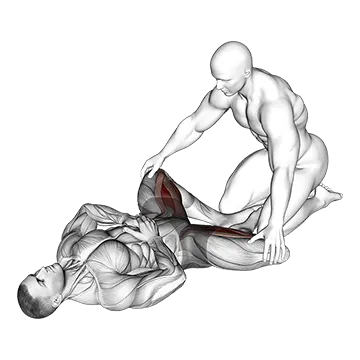 Assisted Lying Adductors StretchHips
 Assisted Lying Gastrocnemius StretchCalves
 Assisted Lying Gluteus And Piriformis StretchHips
 Assisted Lying Gluteus Maximus StretchHips