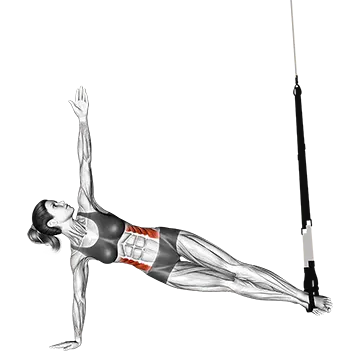
Suspension Twisting Jack Knife
- Target muscle
- Obliques
- Synergist muscles
- Iliopsoas, Tensor Fasciae Latae
- Equipment
- Suspension
- Body part
- Waist
- Type
- Strength
The Suspension Twisting Jack Knife is a core strength exercise that targets the obliques while engaging the iliopsoas and tensor fasciae latae as synergists. Performed with suspension straps, it combines a pike movement with a rotational pull, demanding both anti-rotation stability and dynamic hip flexion through an unstable plane.
How to do the Suspension Twisting Jack Knife
- 1Anchor the suspension straps overhead and shorten them so the foot cradles hang around ankle to mid-shin height, then kneel and place both feet in the cradles, laces down.

- 2Walk your hands out into a push-up plank position with arms fully extended, wrists under shoulders, and body in a straight line from head to heels.
- 3Brace your core and squeeze your glutes to stabilize the plank before initiating any movement.

- 4Exhale and drive both knees toward your left armpit by flexing the hips and rotating the pelvis to the left.
- 5Pause briefly when the knees are as close to the armpit as your range of motion allows.
- 6Inhale and extend the hips slowly, returning your feet to the starting plank position under control.
- 7On the next repetition, drive both knees toward the right armpit, alternating sides each rep.
- 8Complete the prescribed number of repetitions per side while maintaining a neutral spine throughout.
Form tips
- Keep your hips level at the start of each rep — letting them sag or pike before you rotate shifts work away from the obliques.
- Lead the rotation with your hips and knees, not by twisting your shoulders; your upper body should stay square to the floor.
- Control the return phase — resisting the straps as you extend is where much of the oblique demand occurs.
- Press firmly through your palms throughout the movement to keep your shoulder girdle stable and protect your wrists.
- If the movement feels jerky, slow the tempo to a 2-second pull and 2-second return until you build consistent control.
Common mistakes
- Allowing the hips to sag during the plank hold — a dropped pelvis places stress on the lower back and reduces oblique activation for the entire set.
- Rotating the shoulders instead of the hips — twisting the torso rather than the pelvis turns the exercise into a shoulder movement and removes the rotational load from the obliques.
- Rushing the return — swinging the feet back using momentum rather than controlling the extension eliminates the eccentric stimulus and increases injury risk at the hip flexors.
- Pulling the knees too far past the armpit — over-rotating beyond your stable range strains the lower back and disrupts shoulder alignment.
- Holding your breath — failing to exhale on the pull increases intra-abdominal pressure in an uncontrolled way and disrupts core bracing rhythm.
Frequently asked questions
What muscles does the Suspension Twisting Jack Knife work?
The primary target muscle is the obliques. The iliopsoas and tensor fasciae latae act as synergists, driving hip flexion to pull the knees toward each armpit during each repetition.
How is the Suspension Twisting Jack Knife different from a regular suspension jack knife?
The standard jack knife pulls the knees straight toward the chest in the sagittal plane, emphasizing the rectus abdominis. The twisting variation drives the knees toward alternate armpits, adding a rotational component that shifts the primary demand onto the obliques.
How long should the suspension straps be set for this exercise?
Set the foot cradles at approximately mid-shin to ankle height when you are standing upright — low enough that your body forms a straight plank line when you walk out into position, but not so low that your hips drop immediately.
Can beginners do the Suspension Twisting Jack Knife?
This exercise demands solid plank stability and hip-flexor control. Beginners should first build competence with standard suspension plank holds and basic jack knifes before adding the rotational component. If the hips cannot stay level through a full rep, regress until core stability improves.
How many sets and reps are recommended for the Suspension Twisting Jack Knife?
For strength and core endurance, 3–4 sets of 8–12 repetitions per side is a common starting point. Because oblique fatigue accumulates quickly with the rotational demand, rest 60–90 seconds between sets to maintain quality form.